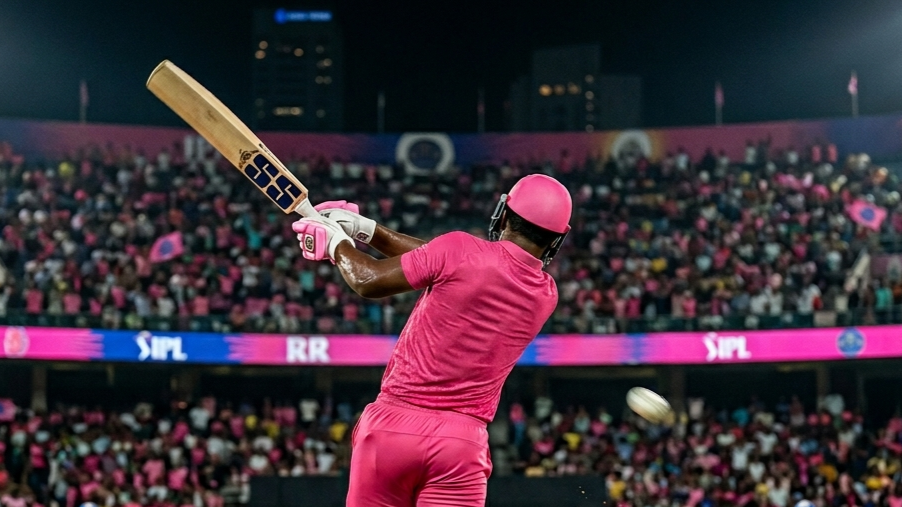
There’s a moment from Guwahati on Tuesday that says everything. Jasprit Bumrah — the best bowler on the planet on most days — sends one into the slot against 14-year-old Vaibhav Sooryavanshi. It goes over mid-on for six. And then Bumrah almost laughs.
That laugh told the whole story. When a bowler laughs, it is rarely because something is funny. More often, it is because of what has broken through their working composure — the quiet admission that a plan has failed before it was properly formed.
When the Best Bowler in the World Starts Second-Guessing Himself
Dale Steyn recognised it straight away. Speaking on ESPNcricinfo’s TimeOut show after Rajasthan Royals dismantled Mumbai Indians in their IPL 2026 clash, Steyn said Sooryavanshi has done something uncommon — he’s gotten inside bowlers’ heads before a ball is even bowled.
“That delivery from Bumrah. That’s in the slot. That’s so rare of Bumrah,” Steyn said. “So even the great Bumrah is thinking in the back of his mind: ‘don’t get it wrong, because if I get it wrong, this guy’s going to hit me for six’.” And that’s exactly what happened.
The Psychology Behind a 14-Year-Old Rewriting the Rules
Aaron Finch had a theory about what Bumrah was actually trying to do — an inswinging yorker, first ball, targeting Sooryavanshi’s high back lift. A reasonable plan. But the execution went sideways, and Finch pointed to something more telling than poor skill.
“It’s amazing the effect that your mind has on your skill level,” Finch said. “If you’re thinking, ‘oh, don’t miss in the slot’, what do you do? You miss in the slot.” Every time!
Sports psychologists have written about this specific mechanism for decades. Jonny Wilkinson, England’s most obsessive kicker in rugby history, described in his 2008 memoir how the instruction “don’t miss left” reliably produced left misses in high-pressure Tests — the brain processes the image of failure first, and the body follows. Shane Warne said something similar about facing Brian Lara in the late 1990s. He found that thinking “don’t serve up a half-volley” was no different from ordering his arm to deliver one. “I feel, if you think like that, more often than not, you do get it wrong,” Steyn agreed.
Sooryavanshi’s 39 Off 14 Balls Set the Tone
The numbers were stark. RR posted 22 off the very first over — bowled by Deepak Chahar — and were 80 for 1 after five. In an 11-over-a-side game, that’s more or less a death sentence for the team chasing. Sooryavanshi hit 39 off just 14 balls. Then Yashasvi Jaiswal made 77 not out off 32. RR finished on 150 for 3.
MI’s Honest Admission After the Collapse
Mumbai Indians coach Mahela Jayawardene didn’t dress it up. He said MI had plans against both Jaiswal and Sooryavanshi. They just never executed them.
“We missed our lengths, we missed our lines, and they played really, really well,” Jayawardene said after the loss. That kind of candor is rarer than it sounds. When a 17-year-old Virat Kohli made his Ranji debut in 2006, captain Mithun Manhas admitted afterwards that several bowlers had tightened up mid-spell — the teenager’s reputation from age-group cricket had preceded him onto a professional ground.
Credit to MI though — they did claw some control back between overs six and ten, with only 52 runs coming in that stretch. But the first five overs had already decided the game. MI finished on 123 for 9. Twenty-seven runs short. That was that. Four sixes, Jayawardene noted, was the real margin of difference.
What Bowlers Are Supposed to Do — and Why It’s Harder Than It Sounds
Steyn’s advice was straightforward enough in theory: drag length back, hit a good length; and you might be in the game. Miss, and the ball’s going to travel — “doesn’t matter who you are, Bumrah or Joe Average.”
But knowing the right length is one thing. Executing it under pressure, against a teenager who doesn’t seem to feel fear, is something else entirely. His reputation has formed fast enough that even the game’s elite are adjusting their thinking at the top of their run-up. At fourteen. Still in school.
The Fear Factor Sooryavanshi Has Already Built
Bumrah will be fine. He’ll work it out, as he always does. But Tuesday in Guwahati was a reminder that batting genius — real, destabilising genius — doesn’t wait for the right age, the right occasion, or the right opponent.
It just hits over mid-on and watches you laugh.
 Cricket Masala
Leave a comment