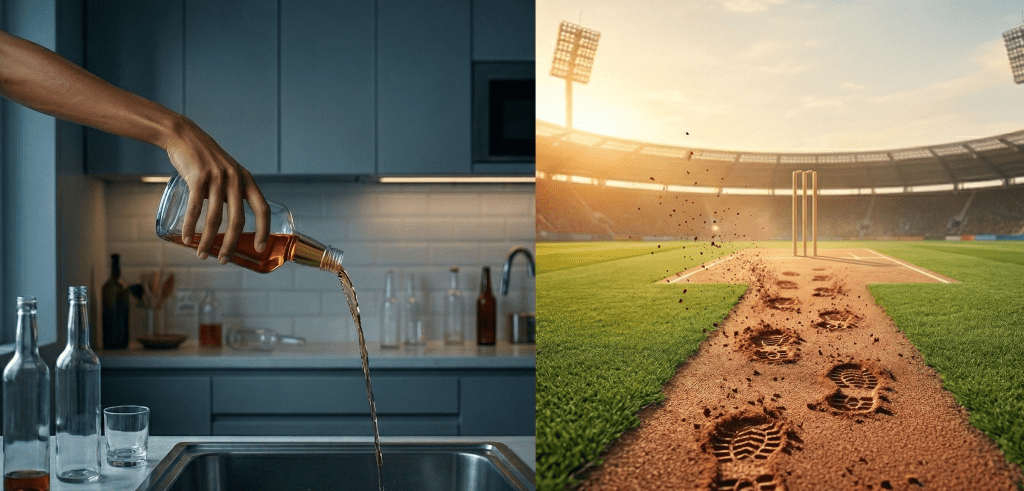
Yuzvendra Chahal has stopped drinking!!
It’s been more than six months since the 34-year-old Indian leg-spinner touched alcohol, part of a deliberate overhaul aimed at keeping his body match-ready through what could be the twilight stretch of his IPL career. Chahal’s new regimen comes after a brutal 2025 season with Punjab Kings — one that saw him fracture his hip against Kolkata Knight Riders, then fracture his knuckle later in the tournament, leaving him compromised during PBKS’s first IPL final appearance in 11 years.
“Now, I’m 35, I want to be more active and give my 150% for my team,” Chahal told AB de Villiers on the South African’s YouTube channel AB de Villiers 360. “As a senior bowler and senior player, people will see me [and think] ‘this guy, we have to learn something from him.’”
That mindset — part mentor, part warrior — shows where Chahal sits in the IPL ecosystem these days. He’s no longer the young gun who bamboozled batsmen at Royal Challengers Bangalore or Rajasthan Royals. He’s the veteran who younger spinners study. And that role, he’s learned, calls for a different kind of commitment.
Thing is, Chahal’s 2025 season looked promising until his body betrayed him. He played 14 of PBKS’s 17 league matches before the injuries stacked up. By the time the knockouts arrived — the Qualifier and the final — he couldn’t bowl his proper leg-spin.
The fractures had robbed him of the wrist snap and finger control that made him dangerous. PBKS reached the final anyway, but Chahal knew he’d been a passenger when his team needed him most. So the offseason became about repair and prevention. Quitting alcohol wasn’t the only change, but it’s the one that broadcasts intent.
For a professional athlete in his mid-30s, alcohol is trouble. It’s the inflammation, recovery time, sleep quality, hydration — all the under-the-hood stuff that separate a 35-year-old who’s still sharp from one who’s fading.
Chahal’s decision is what other aging athletes have done when they want to stretch their careers — Roger Federer famously tightened his schedule and recovery protocols in his 30s while LeBron James spends over a million dollars annually on body maintenance. Cristiano Ronaldo became obsessive about diet and sleep. It’s not just about staying fit — it’s about keeping pace with younger versions of yourself who are faster, hungrier, less banged up.
Take Imran Tahir — the South African leg-spinner kept himself match-fit well into his late 30s by reworking his diet and training routine around 2016. He was still bowling four-over spells in franchise leagues at 41, spinning googlies with the same snap he had a decade earlier. That works. The difference wasn’t talent; it was the unglamorous work between matches that most fans never see.
And Chahal’s got company in the PBKS dressing room this season. Coach Ricky Ponting and captain Shreyas Iyer — two men who’ve worked together before at Delhi Capitals — are setting the standard.
“Ricky and Shreyas worked together during the IPL at DC,” Chahal said. “So they have that bonding. Same with Shreyas. You don’t feel like he’s your captain — he’s your friend only.”
That clarity counts! For more than fans realise, actually — IPL squads are mercenary, players shuffle teams every auction, coaches rotate, roles blur.
When a veteran like Chahal knows exactly what’s expected of him, he can prepare with precision instead of guessing. Ponting’s reputation for straight talk and accessibility fits. So does Iyer’s leadership style, which apparently doesn’t do the hierarchy thing.
There’s a case from IPL 2023. A veteran spinner at Sunrisers Hyderabad spent half the season unsure whether the management wanted him as a powerplay enforcer or a middle-overs accumulator. The mixed signals ate at his confidence — he’d train for one role, then get deployed in another. By mid-season, his economy rate had ballooned and the franchise benched him for the playoffs.
Role confusion doesn’t just hurt performance; it wrecks the mental preparation that separates good seasons from great ones.
Iyer himself had a redemptive 2025 season after being released by Kolkata Knight Riders following their title defence. He landed at PBKS as captain and led them to that maiden final appearance — proof that the franchise’s decades of underachievement could be reversed. Now they’re trying to build momentum instead of starting from scratch again, which is rare for a team that’s historically churned through talent like a blender.
Chahal’s injuries last season were the kind that don’t make headlines but kill performance. A fractured hip limits a bowler’s pivot. Limits stride too.
A fractured knuckle — especially on the bowling hand — is worse. It wipes out the ability to impart spin entirely. Leg-spinners rely on finger pressure and wrist rotation to generate turn and dip, so without full strength in those joints, the ball just floats.
Still, he bowled through it during the knockouts. That’s the part that makes his offseason commitment less surprising. Athletes who’ve played hurt often get obsessive about prevention afterward. The pain lingers in muscle memory even after the bone heals.
PBKS opens IPL 2026 against Gujarat Titans in Mullanpur on March 31st — a home match at the Maharaja Yadavindra Singh International Cricket Stadium. It’s the kind of opener that could set the tone for the entire campaign. Last season GT finished mid-table, so they’re beatable. But PBKS will need their senior bowlers firing from match one if they want to replicate last year’s finals run.
Chahal’s arc in the IPL has always been underrated outside hardcore cricket circles. He’s taken over 200 wickets in the tournament — one of only a handful of bowlers to crack that mark — but he’s never won a title. He’s been the bridge between eras at multiple franchises, the guy who steadies innings when hitters are going berserk, the one who bowls the tough overs in the middle when captains need control.
But leg-spin is a young man’s craft in T20 cricket, where the margin for error tightens every season as batsmen get better at picking variations, as grounds get smaller, as pitches get flatter. Chahal’s betting that fitness — the boring, daily grind of it — can buy him a few more elite years.
One leg-spinner who learned this the hard way was Amit Mishra. After recurring finger and shoulder injuries starting around 2018, Mishra’s economy rate crept upward each season — from under 7 in his prime to over 8.5 by his early 30s. The variations were still there in his head; his body couldn’t execute them with the sharpness batsmen feared.
By 2022, at 39, he was out of the IPL entirely. The lesson: for a wrist spinner, physical decline doesn’t come gradually — it’s a cliff.
Six months without alcohol doesn’t sound like much. For a professional athlete in a sport where careers routinely end in the early 30s, though, it’s a flag in the ground. It says he’s not coasting. It says he’s willing to trade comfort for longevity.
And it says PBKS — a franchise that’s never won an IPL title despite 18 seasons of trying — might finally have a core group willing to make the sacrifices that separate finalists from champions.
 Cricket Masala
Leave a comment